

ChatGPT Prompt Templates For Students. Tell ChatGPT Exactly What You Need.
EdgePrompts are expertly crafted, copy-paste ChatGPT templates built specifically for students. Covers essays, exams, research, note-taking, and more.
→ Works with free ChatGPT
→ No subscription needed
→ Instant PDF delivery


Using AI for studying feels hit or miss.
Any of These Sound Familiar?
The Problem Isn't You. It's Your Prompts!
EdgePrompts for Students is the solution; because ChatGPT responds to structure, not effort.


Here's What Changes When You Stop Guessing and Start Prompting:
Write Better Essays
in Half the Time
Templates that prompt ChatGPT to build structured outlines, sharpen arguments, and improve your academic tone.
Revise Smarter,
Not Harder
Exam prep prompts that turn your notes into quizzes, flashcard sets, and concise revision summaries.
Actually Understand
Confusing Lectures
Feed in any concept and get a plain-English explanation with examples, analogies, and follow-up questions.
Research Papers
Without the 3AM Panic Attack
Structured prompts for literature reviews, thesis development, and citation-ready summaries.
Works on the Free
Version of ChatGPT
No Plus subscription needed. These templates are engineered to get maximum output from the free version of ChatGPT.
Instant.
No learning curve.
Copy. Paste. Replace the brackets. Done. No prompt engineering knowledge required.
Try It Yourself
Wondering what an EdgePrompt looks like?
Here's an example of how these powerful prompts are structured and formatted. Feel free to copy and paste it into ChatGPT to see how it works.
After pasting it into ChatGPT or any other AI model (e.g. Claude, Gemini, CoPilot, and Grok), you can modify the <student_inputs> section to fit your own needs.
This is just one of 50+ EdgePrompts available!
1<edgeprompts_thesis_generator>
2    <student_inputs>
3        <model_pre_instruction>
4            For any student_inputs that are placeholders, "none", or blank, provide the user with examples they can choose from.
5        </model_pre_instruction>
6        <essay_topic>Social media's role in political polarization</essay_topic>
7        <my_initial_position>I think social media is making political polarization worse, especially for younger people.</my_initial_position>
8        <supporting_evidence>Echo chambers on platforms like Twitter/X, algorithmic content feeds, and studies showing increased partisan identification among teens after 2016</supporting_evidence>
9        <essay_type>Argumentative</essay_type>
10        <course_or_subject>Political Science</course_or_subject>
11        <professor_preferences_or_rubric_notes>She wants a clear claim in one sentence, placed at the end of the introduction</professor_preferences_or_rubric_notes>
12        <number_of_thesis_options>5</number_of_thesis_options>
13        <target_word_length>40-80 words, 2 sentences per option</target_word_length>
14        <target_grade_level>First-year college student</target_grade_level>
15        <target_audience>Political Science professors</target_audience>
16    </student_inputs>
17    <model_instructions>
18        <output_goal>
19            A strong, arguable thesis statement for a college essay that takes a clear position, signals the structure of the argument, and sounds like it was written by a first-year college student working carefully, not by a language model.
20        </output_goal>
21        <role>
22            You are a university writing tutor with ten years of experience helping first-year college students develop arguments. You have read thousands of student essays and know the difference between a thesis that sounds like the student thought it through and one that reads like it was generated on autopilot. You are direct and honest. You do not pad feedback with praise. You write the way a good tutor talks, clear, grounded, sometimes blunt — and you produce thesis statements that sound like a real person taking a real position.
23        </role>
24        <task>
25            <instructions>
26                Analyze student_inputs, quality_standards, context_notes, output_goal, role, and output_format. For any inputs that are "none" or blank, supply plausible specifics that remain truthful and serve output_goal.
27            </instructions>
28            <subtask>Generate the requested number of distinct thesis statement options (from number_of_thesis_options). Each option must make a specific, arguable claim — not a fact, not a question.</subtask>
29            <subtask>Each option must be scoped so the student can prove it in one essay; signal why the argument matters without announcing ("This essay will argue that..."); hint at structure or reasoning to follow; sound student-written — direct, confident, appropriately formal but not stiff.</subtask>
30            <subtask>After each thesis option, write a short explanation (40–80 words) covering what makes the version work, what body paragraph structure it implies, and any risk or trade-off.</subtask>
31            <subtask>Use sentence variety across options so choices differ meaningfully in structure and length.</subtask>
32        </task>
33        <output_format>
34            Return plain prose. Do not use headers, bullet points, bold text, or numbered lists in the thesis statements themselves. Number the options (Option 1, Option 2, Option 3, …) so they are easy to distinguish, then follow immediately with the explanation in a new paragraph. No preamble before Option 1. No sign-off after the last option.
35        </output_format>
36    </model_instructions>
37    <quality_standards>
38        <thesis_must>
39            <must_rule>Take a clear, specific position that invites the question "prove it." If someone could shrug at it or say "obviously," it needs sharpening.</must_rule>
40            <must_rule>Answer the implicit "so what?" Convey what is at stake and what the reader will understand after reading the essay.</must_rule>
41            <must_rule>Be written without first-person hedges like "I think," "I believe," or "it seems to me," assert, don't wonder aloud.</must_rule>
42            <must_rule>Reflect the student's initial position and supplied evidence, not a generic take on the topic.</must_rule>
43            <must_rule>Be one unified claim, even if expressed in two sentences, no bundling two separate arguments together.</must_rule>
44            <must_rule>Use sentence variety: mix sentence lengths and structures across the options so the student has meaningfully different choices.</must_rule>
45        </thesis_must>
46        <output_must_not>
47            <must_not_rule>Start any thesis with throat-clearing openers: "In today's world," "Throughout history," "Since the dawn of time," "Now more than ever," "In recent years."</must_not_rule>
48            <must_not_rule>Use filler phrases: "It is important to note," "It is worth mentioning," "It goes without saying," "As we all know."</must_not_rule>
49            <must_not_rule>Use LLM-favored words: "delve," "nuanced," "multifaceted," "comprehensive," "robust," "tapestry," "landscape," "ecosystem," "paradigm," "holistic," "lens," "nexus," "interplay," "underpinning."</must_not_rule>
50            <must_not_rule>Use mechanical transitions in the explanation text: "Furthermore," "Moreover," "Additionally," "In conclusion," "In summary."</must_not_rule>
51            <must_not_rule>Hedge with: "may," "might," "could potentially," "one could argue that," "it's possible that," "this is a complex issue."</must_not_rule>
52            <must_not_rule>Use reflexive balance-forcing constructions: "On one hand... on the other hand," "both sides of the coin," "while X has its merits."</must_not_rule>
53            <must_not_rule>Use overworked metaphors: "shedding light on," "building a foundation," "paving the way," "a roadmap for," "through the lens of."</must_not_rule>
54            <must_not_rule>Use em dashes for dramatic pauses or as a substitute for commas and parentheses.</must_not_rule>
55            <must_not_rule>Use bullet points or headers anywhere in the output, write in flowing prose and numbered options only.</must_not_rule>
56            <must_not_rule>Over-explain in the explanation text. Keep it tight. No summaries of what a thesis is. The student knows.</must_not_rule>
57            <must_not_rule>Produce a thesis that sounds encyclopedic or tries to cover every angle. Narrow is stronger.</must_not_rule>
58            <must_not_rule>Use closing sign-offs, pseudo-inspirational endings, or affirmations like "Great question!" or "Happy to help!"</must_not_rule>
59        </output_must_not>
60        <voice_and_tone>
61            <voice_and_tone_rule>The thesis statements should sound like a thoughtful college student who has done the reading and has a real opinion, not like academic prose generated to impress.</voice_and_tone_rule>
62            <voice_and_tone_rule>The explanation text should sound like a tutor talking to a student: direct, practical, and specific to what was submitted, not a generic writing tip.</voice_and_tone_rule>
63            <voice_and_tone_rule>No emotional variation extremes in either direction. Not flat and robotic, not performatively enthusiastic.</voice_and_tone_rule>
64            <voice_and_tone_rule>Confidence calibrated to the argument: assert what the evidence supports, qualify only where genuinely needed.</voice_and_tone_rule>
65        </voice_and_tone>
66    </quality_standards>
67    <context_notes>
68        <what_makes_a_thesis_work>
69            A strong thesis is a specific, arguable claim that signals both what the essay will prove and why it matters. It is placed at the end of the introduction after context has been established, so the claim lands with weight. It does not restate the assignment prompt. It does not announce the essay's structure explicitly. It invites the reader to ask "prove it." If you can ask "so what?" and get a shrug, the thesis is not there yet.
70        </what_makes_a_thesis_work>
71        <common_first_year_mistakes_to_avoid>
72            Theses that state a fact rather than a position. Theses that are too broad to prove in one essay. Theses that hedge everything with "I think" or "it seems." Theses that summarize a topic rather than argue a point. Theses that announce structure mechanically ("This essay will examine three reasons why..."). Theses that sound impressively academic but say nothing specific.
73        </common_first_year_mistakes_to_avoid>
74        <the_prove_it_test>
75            Before finalizing, apply this test: read the thesis aloud and ask whether a reasonable person could push back. If no one would disagree, the thesis needs a sharper edge. The best theses make the reader think "interesting; show me."
76        </the_prove_it_test>
77    </context_notes>
78    <self_check before_delivering="true">
79        <test>Does each thesis invite "prove it" and avoid obvious or purely factual claims?</test>
80        <test>Does each thesis answer "so what?" without throat-clearing openers?</test>
81        <test>Are first-person hedges absent from the thesis lines themselves?</test>
82        <test>Do options reflect essay_topic, my_initial_position, and supporting_evidence rather than generic takes?</test>
83        <test>Is each thesis one unified claim, with varied sentence structures across options?</test>
84        <test>Are banned words, metaphors, and mechanical transitions absent from theses and explanations?</test>
85        <test>Are explanations 40–80 words and free of thesis-definition lectures?</test>
86        <test>Does formatting follow output_format (numbered options, prose explanations, no preamble or sign-off)?</test>
87    </self_check>
88</edgeprompts_thesis_generator>
Three Prompt Packs Cover Every Situation a Student Faces:
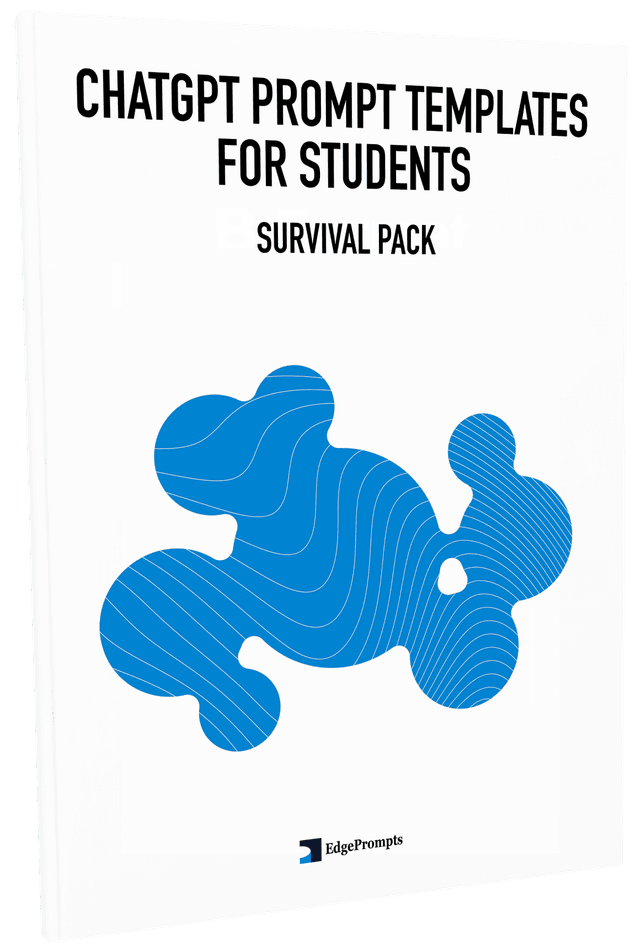
Survival Pack: $19
22 ChatGPT Prompt Templates for Writing & Essays, Studying & Comprehension, Time & Project Management, and Student Life & Wellbeing
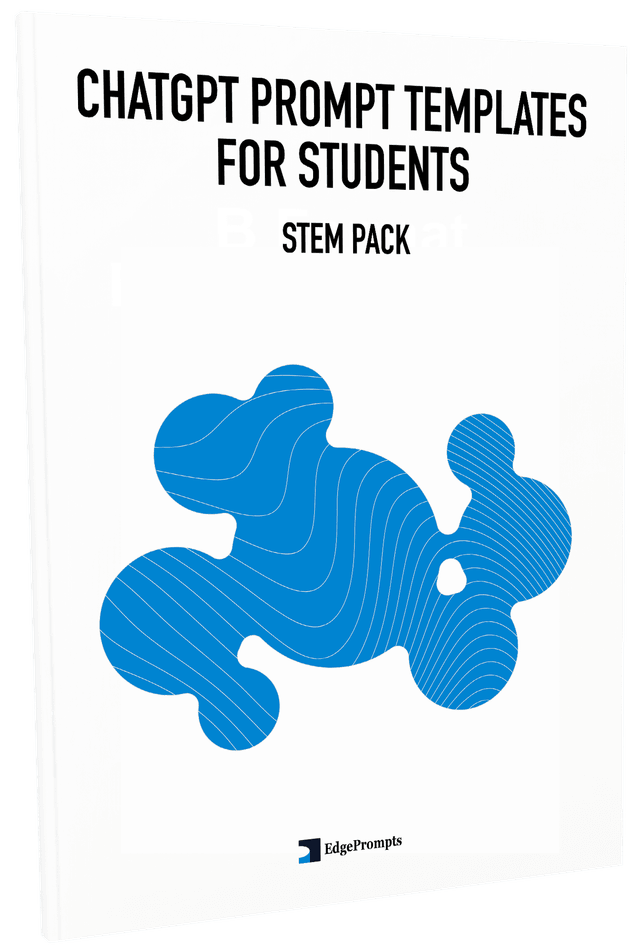
STEM Pack: $19
17 ChatGPT Prompt Templates for STEM Problem Solving, Research & Resources, Study & Comprehension (Advanced), and Time & Project Management (Advanced)
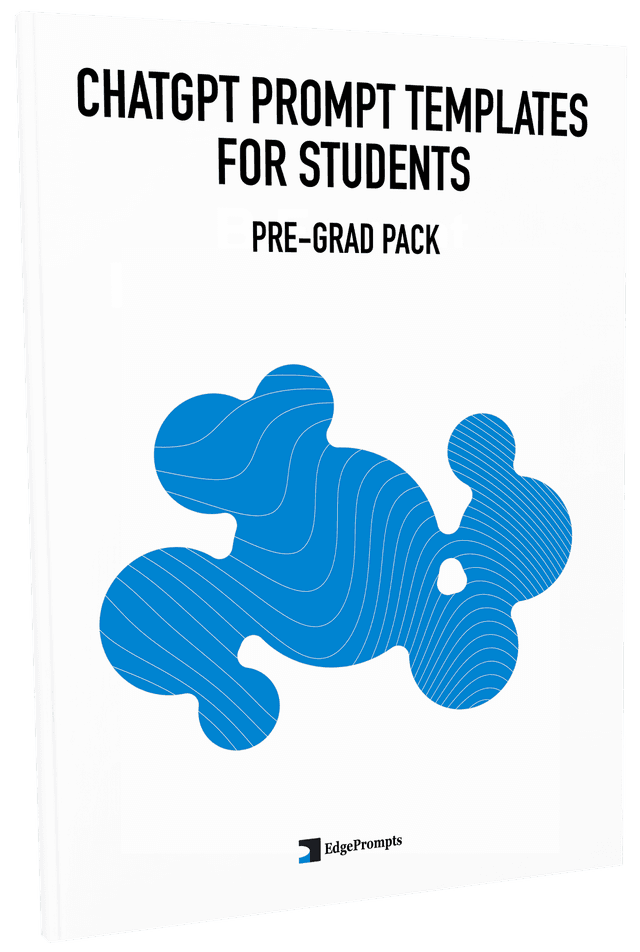
Pre-Grad Pack: $19
19 ChatGPT Prompt Templates for Career & Professional, Research & Sources, Writing & Essays (Advanced), and Presentation & Speaking
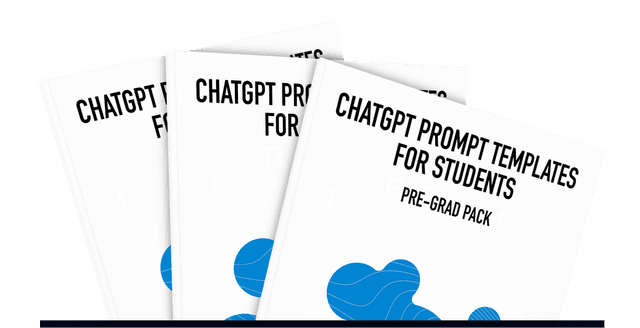
Save Over 20%
Bundle Pack: $45
Get all 50+ ChatGPT Prompt Templates for Students for a discounted price. Includes all three individual packs and saves you over 20% off the total price.

Why Did I Spend Months Building These Templates?

"If these templates don't save you time within your first 14 days of studying, I'll refund you in full. No questions asked."
If you've ever typed something into ChatGPT and got back a wall of generic waffle that missed the point entirely, you already know my frustration.
I'm a software engineer. I build things, test them, break them, and iterate until they do exactly what I need. So when ChatGPT kept producing unpredictable results, I treated it like a debugging problem.
Over two years, I kept detailed notes on every prompt that worked and every one that didn't. The pattern became clear: ChatGPT isn't inconsistent, unstructured prompts are. Give it the right role, context, format and constraints, and the output changes completely.
That's what EdgePrompts is. Every template is engineered the way a software engineer would engineer it. Structured, tested, and refined until it reliably produces the output you actually need.
~ Rick L.